Texas, THC, and the New American Cannabis Debate: How the Lone Star State Became Ground Zero for Hemp and Cannabis Policy
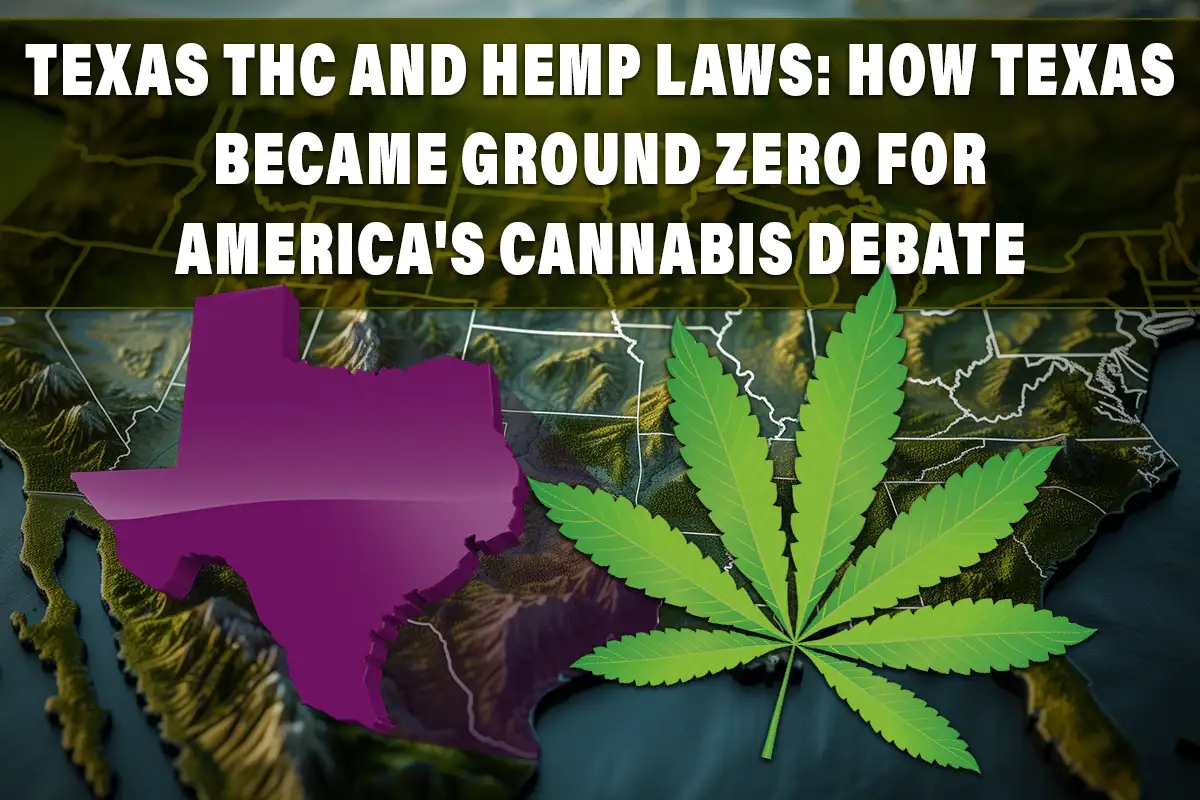
Texas has become one of the most important and complicated states in America’s evolving debate over cannabis, hemp, and THC.
That may sound surprising. Texas is not traditionally associated with recreational marijuana legalization, and the state continues to maintain some of the nation’s more restrictive cannabis laws. Yet over the past several years, Texas has found itself at the center of a national conversation about hemp-derived THC, Delta-8 THC, Delta-9 THC, cannabis legalization, marijuana policy, medical marijuana, and the future of the American cannabis industry.
The reason is relatively simple: Texas became a laboratory for what happens when federal and state cannabis laws don’t perfectly align.
The story begins with the 2018 federal Farm Bill, which created a legal distinction between hemp and marijuana based primarily on the concentration of Delta-9 THC. Hemp containing no more than 0.3% Delta-9 THC was removed from the federal definition of marijuana.
Texas subsequently adopted its own hemp framework through House Bill 1325 in 2019, creating a legal pathway for hemp production and consumable hemp products containing no more than 0.3% Delta-9 THC.
What happened next changed the conversation.
Products containing cannabinoids such as Delta-8 THC and Delta-10 THC began appearing throughout the Texas marketplace. Gummies, beverages, tinctures, vapes, smokable products, and other hemp-derived THC products became widely available despite Texas maintaining a comparatively restrictive traditional marijuana system.
Texas had unintentionally created one of the largest real-world experiments in the country concerning the distinction between hemp and marijuana.
And in 2026, that experiment entered a dramatically different phase.
Texas Didn’t Legalize Marijuana, It Helped Expose the Problem With the Definition of Hemp
One of the biggest misconceptions surrounding Texas THC laws is that Texas “legalized marijuana.”
Instead, Texas legalized hemp within the boundaries established by federal law and created a regulatory structure for hemp production and consumable hemp products.
That distinction is critical.
Under the original federal definition established by the 2018 Farm Bill, hemp was defined as Cannabis sativa L. and its derivatives containing no more than 0.3% Delta-9 THC by dry weight. Marijuana remained federally controlled.
The important phrase was Delta-9 THC.
That distinction created an opening for entrepreneurs and cannabinoid manufacturers.
Cannabis contains numerous cannabinoids. Delta-9 THC is the cannabinoid most commonly associated with the intoxicating effects of traditional marijuana, but it is not the only THC molecule capable of producing intoxicating effects.
As hemp processing technology developed, manufacturers discovered ways to extract CBD from hemp and convert or formulate cannabinoids into products containing compounds such as Delta-8 THC and Delta-10 THC.
The result was a rapidly expanding category commonly referred to as hemp-derived THC.
The products could contain intoxicating cannabinoids while remaining below the federal 0.3% Delta-9 THC threshold.
That distinction became the foundation of the modern Texas THC controversy.
Why Texas Became Ground Zero
Texas was uniquely positioned to become a major testing ground for this emerging industry.
The state has:
- A massive population
- A large agricultural economy
- A substantial retail sector
- A comparatively restrictive traditional marijuana program
- A statewide hemp regulatory framework
- A large network of convenience stores, smoke shops, CBD retailers, and specialty retailers
- Significant political disagreement over cannabis policy
Those factors created a market where consumers could have access to intoxicating hemp-derived THC products without having access to a traditional recreational marijuana dispensary system.
That is an unusual situation.
In a state where traditional marijuana remains heavily restricted, consumers could nevertheless encounter Delta-8 gummies, hemp-derived Delta-9 products, THC beverages, CBD products, and other cannabinoid products at retail locations that did not resemble conventional cannabis dispensaries.
The distinction between “hemp” and “marijuana” consequently became much more complicated for consumers.
A product could be made from cannabis.
It could produce intoxicating effects.
And yet it could potentially qualify as hemp under the federal definition.
That contradiction is at the heart of the national cannabis debate.
The 2018 Farm Bill Changed Everything
To understand Texas THC legalization and the national hemp market, it is necessary to understand the 2018 Farm Bill.
Before 2018, federal law generally treated cannabis and its derivatives as marijuana under the Controlled Substances Act, with narrow exceptions.
The 2018 legislation created a separate legal category for hemp.
The federal definition focused on a threshold of 0.3% Delta-9 THC by dry weight. Hemp was removed from the federal definition of marijuana, although the FDA retained authority over hemp-derived products falling within its regulatory jurisdiction.
This produced an enormous new commercial opportunity.
Cannabinoid products could be manufactured.
And entrepreneurs began looking for opportunities within the boundaries of the new law.
The cannabis industry quickly learned that the legal definition of a plant or product could be just as important as the chemistry inside it.
Enter Delta-8 THC
Delta-8 THC became one of the most important developments in the modern hemp industry.
Chemically related to Delta-9 THC, Delta-8 can produce intoxicating effects, although it is generally considered less potent than Delta-9.
Because the original federal hemp definition focused specifically on Delta-9 THC, companies began marketing products containing other cannabinoids derived from hemp.
This created a new market for hemp-derived THC products.
Texas became one of the largest and most visible examples of this phenomenon.
Retailers began selling THC gummies, Delta-8 gummies, Delta-8 vape products, Delta-10 products, THC beverages, tinctures, and other cannabinoid products.
The market expanded rapidly.
But so did the controversy.
Critics argued that the hemp industry had found a loophole allowing intoxicating cannabis products to be sold outside the tightly controlled marijuana dispensary system.
Industry advocates argued that these products were lawful hemp products under the language Congress had established.
That disagreement eventually became a major legal battle.
The Texas THC Legal Battle
Texas regulators and the hemp industry eventually found themselves on opposite sides of the question.
The Texas Department of State Health Services moved to clarify its position regarding Delta-8 THC and other cannabinoids.
The hemp industry challenged those actions in court.
The dispute became far more than a question about one cannabinoid.
It became a constitutional, statutory, regulatory, and commercial debate over a fundamental question:
The Texas Supreme Court ultimately allowed the state to enforce its position regarding Delta-8 THC and related cannabinoids.
Texas DSHS now states that the Texas scheduling action affecting Delta-8 THC became effective July 31, 2026, and that only trace amounts of naturally occurring Delta-8 in hemp are permissible under the state’s current framework.
That makes 2026 a significant turning point in the Texas cannabis story.
Texas THC Laws in 2026: A Major Reversal
The Texas hemp market that developed after 2019 is now facing a very different regulatory environment.
As of July 31, 2026, Texas began enforcing restrictions that classify Delta-8 THC and other THC isomers, including Delta-10, as controlled substances, while limited Delta-9 THC products meeting the applicable hemp threshold remain treated differently.
For consumers and retailers, the distinction is enormously important.
A product labeled “hemp” is not automatically legal simply because it comes from hemp.
A product containing “THC” is not automatically equivalent to traditional marijuana either.
The specific cannabinoid, concentration, source, formulation, and applicable state and federal law all matter.
That is why consumers searching for phrases such as “Is Delta-8 legal in Texas?”, “Texas THC laws,” “Texas hemp laws,” “legal THC in Texas,” “hemp-derived THC Texas,” and “Delta-9 THC Texas” may encounter seemingly contradictory information online.
The laws are changing faster than the terminology.
The Bigger National Problem: Hemp, Marijuana, and THC Are Not the Same Thing
Texas illustrates a problem that exists across the United States.
The words cannabis, marijuana, hemp, CBD, and THC are frequently used interchangeably in everyday conversation.
Legally and scientifically, however, they are not interchangeable.
Cannabis
Cannabis is the plant genus.
Both hemp and marijuana come from cannabis.
Hemp
Hemp is a legally defined category of cannabis based largely on THC concentration under federal law.
Marijuana
Marijuana is the term historically used in federal law for cannabis that does not qualify for the hemp exception.
THC
THC refers to a group of cannabinoids rather than a single substance.
Delta-9 THC is the cannabinoid most commonly associated with the traditional marijuana experience.
Other THC-related cannabinoids, including Delta-8 and Delta-10, have generated an entirely new regulatory debate.
CBD
CBD, or cannabidiol, is another cannabinoid found in cannabis.
Unlike Delta-9 THC, CBD is not generally intoxicating.
However, CBD products can still be subject to federal and state regulations depending on how they are formulated and marketed.
This distinction is essential for understanding the modern cannabis industry.
The National Cannabis Industry Is Moving Toward a New Regulatory Model
The Texas debate is occurring at the same time that cannabis policy is changing nationally.
For decades, American cannabis policy operated under a relatively straightforward framework:
Marijuana = illegal federally.
The legalization movement disrupted that framework.
Today, states have created medical cannabis programs, adult-use marijuana markets, decriminalization policies, hemp programs, CBD regulations, and highly specialized cannabinoid rules.
The result is not one American cannabis market.
California has a mature adult-use marijuana market.
Colorado has one of the country’s longest-running regulated recreational cannabis programs.
Other states have medical marijuana systems.
Some states permit limited cannabinoid products.
Some prohibit intoxicating hemp-derived THC.
Texas occupies a particularly interesting position because it has simultaneously maintained strict marijuana laws while becoming a major battleground over hemp-derived THC.
The Federal Government Is Also Rewriting the Rules
The national discussion has now moved beyond the original 2018 Farm Bill.
In November 2025, Congress enacted Public Law 119-37, which amended the federal definition of hemp. The amended definition moves away from measuring only Delta-9 THC and instead uses a total THC concentration, including THCA.
The new framework also establishes additional restrictions on certain hemp-derived cannabinoid products.
Importantly, the changes do not take effect immediately. The amended federal hemp definition is scheduled to become effective 365 days after enactment.
That means the national hemp industry is entering another major period of regulatory uncertainty.
The same loophole that helped create the modern hemp-derived THC industry is being narrowed.
And Texas is already moving aggressively in the same direction.
Why This Matters to Consumers
For consumers, the Texas THC debate is not merely political.
It affects what people can buy, where they can buy it, how products are labeled, how products are tested, and what happens if a product is suddenly classified as illegal.
Consumers should pay attention to:
Certificate of Analysis (COA):
Laboratory testing can provide information about cannabinoid concentrations and contaminants.
Total THC:
Consumers increasingly need to look beyond Delta-9 THC alone.
THCa:
THCA is a non-intoxicating cannabinoid in its raw form but can convert to Delta-9 THC through decarboxylation.
Delta-8 THC:
Delta-8 has been a major component of the hemp-derived THC market but is now prohibited under Texas’ current scheduling framework.
Delta-9 THC:
Low-concentration hemp-derived Delta-9 products occupy a different legal category under the existing federal and Texas frameworks.
Age restrictions:
Texas adopted rules requiring consumable hemp retailers to restrict sales to individuals 21 and older and require government-issued identification.
The takeaway is simple:
A product’s label is not a substitute for understanding the law.
Texas Medical Cannabis Is Another Piece of the Puzzle
It would also be inaccurate to discuss Texas cannabis policy without mentioning medical marijuana.
Texas has a Compassionate Use Program, which provides access to low-THC cannabis for qualifying patients.
The program has expanded considerably from its original form.
In 2025, Texas legislation expanded the Compassionate Use Program and required the Texas Department of Public Safety to issue additional licenses, increasing the number of licensed dispensing organizations and expanding qualifying conditions.
This demonstrates another important feature of Texas cannabis policy:
Texas is not simply “anti-cannabis.”
Instead, Texas has been developing a highly regulated approach in which different categories of cannabis products are treated very differently.
The state can simultaneously permit certain medical cannabis products, regulate hemp products, restrict intoxicating cannabinoids, and continue to prohibit traditional recreational marijuana.
That complexity is precisely why Texas has become such an important case study.
Is Texas Moving Toward Marijuana Legalization?
That question is more complicated than it appears.
The expansion of medical cannabis does not automatically mean Texas is moving toward recreational marijuana legalization.
Likewise, the emergence of hemp-derived THC products did not mean Texas had legalized recreational cannabis.
In fact, the state’s 2026 crackdown demonstrates the opposite.
Texas policymakers have shown a willingness to distinguish between:
- Medical cannabis
- Industrial hemp
- CBD products
- Hemp-derived cannabinoids
- Delta-8 THC
- Delta-9 THC
- Recreational marijuana
- Intoxicating cannabinoid products
The long-term direction remains a political question.
But Texas has unquestionably become one of the most consequential states in the American cannabis debate.
The Great Cannabis Paradox
There is a larger irony at the heart of the Texas story.
The state did not become a national cannabis policy center because Texas legalized recreational marijuana.
It became important because Texas demonstrated what could happen without recreational marijuana legalization.
The hemp industry created an alternative marketplace.
Consumers gained access to THC-containing products.
Retailers created new businesses.
Manufacturers developed new cannabinoid formulations.
And now Congress is responding.
The result is a fascinating feedback loop:
Federal hemp legalization → state hemp programs → cannabinoid innovation → hemp-derived THC market → regulatory controversy → litigation → new state restrictions → federal regulatory changes.
Texas sits directly in the middle of that cycle.
What Happens Next?
The future of THC in Texas will likely depend on several competing forces.
1. Federal hemp regulations
The federal government’s revised definition of hemp could dramatically change which cannabinoid products qualify as hemp.
2. State legislation
Texas lawmakers will continue to determine how aggressively the state regulates hemp, medical cannabis, and marijuana.
3. Court decisions
The Texas THC market has already demonstrated how significant litigation can be in determining whether a cannabinoid product is considered legal.
4. Consumer demand
Perhaps the most powerful force is the marketplace itself.
Millions of Americans are interested in cannabis-derived products, including CBD, THC beverages, gummies, tinctures, medical cannabis, and other cannabinoid products.
Demand is unlikely to disappear simply because lawmakers change definitions.
5. Product innovation
Cannabinoid science continues to evolve.
As manufacturers develop new formulations, regulators will continually be forced to determine where those products fit within existing laws.
Texas Could Become the Blueprint, or the Warning
Texas has spent the last several years demonstrating both the opportunities and dangers of fragmented cannabis policy.
The state created a legal hemp market.
That market grew into a major commercial industry.
Hemp-derived THC products became mainstream.
The industry went to court.
And now Texas has begun aggressively restricting several of the products that helped make the state a national center of the hemp-derived THC conversation.
That makes Texas more than a story about marijuana legalization.
It is a story about regulatory definitions.
It is a story about consumer demand.
It is a story about entrepreneurship and cannabinoid innovation.
And ultimately, it is a story about the difficulty of regulating a plant whose chemistry does not fit neatly into political categories.
The United States is entering a new chapter in cannabis policy.
The first chapter was prohibition.
The second was medical marijuana legalization.
The third was adult-use marijuana legalization.
The fourth may be the normalization and regulation of the broader cannabinoid economy.
That economy includes traditional marijuana, medical cannabis, hemp, CBD, Delta-9 THC, Delta-8 THC, THCA, THC beverages, edibles, tinctures, and emerging cannabinoid products.
Texas has become one of the most important battlegrounds because it sits at the intersection of all of those categories.
The Texas experience also demonstrates why the future of cannabis regulation will probably not be decided by a single question such as “Is marijuana legal?”
The more important questions are becoming:
How is total THC calculated?
How is the product tested?
Which state law applies?
Does the federal definition of hemp still match the way consumers and manufacturers understand hemp?
Those questions are transforming the American cannabis industry.
The Bottom Line
Texas did not become the center of the American cannabis debate by simply legalizing marijuana.
It became the center of the debate because hemp legalization opened a door that neither lawmakers, regulators, consumers, nor the cannabis industry fully understood at the time.
The 2018 Farm Bill created a federal distinction between hemp and marijuana. Texas followed with its own hemp framework in 2019. The resulting market helped turn hemp-derived cannabinoids into a major commercial category. Delta-8 THC and other intoxicating cannabinoids then forced lawmakers and courts to confront the limitations of a legal definition built primarily around Delta-9 THC.
Now the rules are changing again.
Texas is restricting intoxicating hemp-derived cannabinoids, while the federal government has enacted a revised definition of hemp that will place greater emphasis on total THC.
The story is therefore far from over.
If anything, Texas and THC are only the beginning of the next major chapter in America’s cannabis debate.